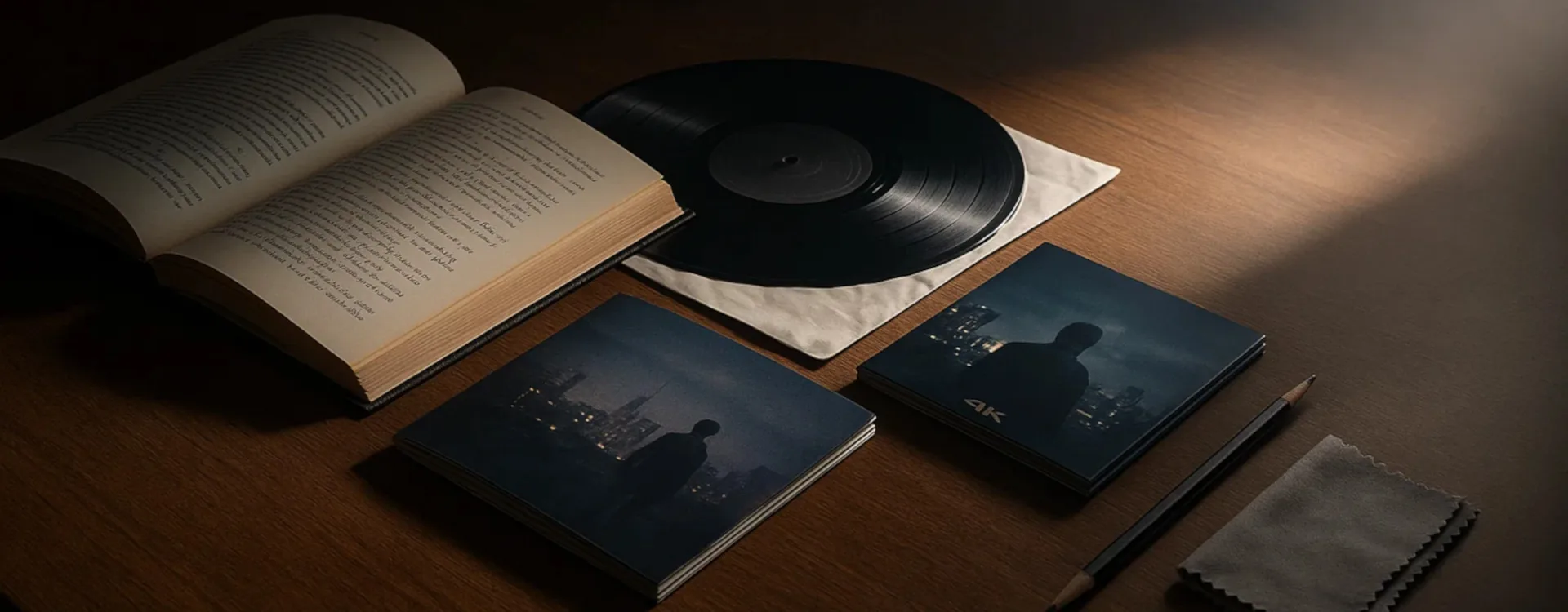
This isn’t nostalgia—it’s biology, psychology, and material culture. We are bodies that think with the body; that’s why vinyl, books, DVDs and other “weighty” objects enable cognitive, emotional, and social functions that streaming and e-books cannot fully replace. Here’s the scientific case.
1) Embodied cognition: we think with our hands
Embodied cognition shows that perception, memory, and decision-making emerge from the coupling of brain, body, and environment. Physical objects provide affordances (weight, texture, size, friction) that guide and stabilize attention. Placing a record on the turntable, flipping a sleeve, or underlining on paper anchors content to episodic and motor memory, improving recall and mental orientation.
- Multisensory encoding: sight + touch + sound → more durable memory traces.
- Spatial indexing: we remember “where” a track/page sits in a physical support (side A, mid-album, right margin)—something linear streams don’t afford.
- Ritual time: the micro-friction of the gesture (open, place, flip) creates anticipation and dopamine peaks that reinforce the experience.
2) The extended mind: owning is also thinking
The extended mind thesis explains how tools and artifacts become parts of our cognitive system. Our “mental library” is more efficient with real shelves: visible covers, spines, thickness, tactile order. Physical objects act as external indices that remind us what we love, enable serendipity, and foster creative recombination (juxtaposing albums, scanning authors with a glance).
3) Psychology of possession: identity, effort, care
Material goods shape identity and social bonds.
- Endowment effect: stable ownership increases subjective value; a revocable stream rarely builds the same attachment.
- Investment & care: cleaning a record, cataloguing, re-sleeving turn consumption into practice, reinforcing belonging and competence.
- Narrativity: a physical collection is a material biography—visible, shareable, inheritable.
4) Material culture: objects as relationships
Anthropologically, objects are carriers of relationships—between people, places, and times. An edition pressed in a given year, with specific materials and production quirks, embeds stories and contexts. Patina—signatures, scuffs, stickers—is embodied memory, not clonable in a file. Objects circulate, are lent, gifted, and thus become social capital.
5) The ecology of attention: limits that liberate
Infinite digital catalogs breed overload, rapid skipping, and shallow listening. Physical media curve attention: finite duration, side A/B, an author’s sequence. Constraint isn’t a bug—it’s a generative limit that favors depth, repetition, and taste formation.
6) Property, rights, and stability over time
To own an object is not the same as to hold a revocable license. Physical goods provide:
- Continuity: access independent of catalogs, DRM, subscriptions, or platform outages.
- Transferability: you can resell, swap, lend, and bequeath them.
- Editorial integrity: works and masterings don’t silently change, and editions remain comparable over time.
7) Symbolic economy: scarcity, value, anchors
Physical markets value print-runs, editions, and condition grades. Verifiable scarcity (copy number, batch, year) generates both use-value and exchange-value. In digital ecosystems, scarcity is artificial and often opaque; in the physical realm it’s auditable, hence credible.
8) Why the “fluid goods” narrative needs scaling down
Streaming and e-books excel at access and portability, but the promise of total replacement collides with structural limits:
- Sensory thinness: files are flat—few tactile/olfactory/visual cues beyond glass screens.
- Catalog fragility: availability shifts, takedowns, silent versioning.
- Infrastructure dependence: platforms, logins, fees, electricity and networks are prerequisites.
- Low identity salience: building a visible, pride-of-place library online is hard; offline, objects furnish, narrate, and educate.
Bottom line: digital is an excellent complement—for discovery, sampling, mobility—but not a universal substitute for material culture.
9) A hybrid model—with a physical backbone
The real future is hybrid: online discovery and convenience; offline rootedness, identity, and memory. Delegate to digital what needs breadth and search; keep as owned, studied, and passed on what works best as an object with a body.
10) Inequality ahead: property as a privilege
Without safeguards we risk a two-tier future: those who can afford it will keep buying physical goods (books, records, collector editions) securing property, transferability, and stability; those who can’t will be confined to time-bound subscriptions, revocable licenses, and volatile catalogs.
Writers and thinkers like Cory Doctorow (on DRM and platform lock-in) and Jaron Lanier (Who Owns the Future?) have long warned that license-mediated access shifts power from people to platforms. Defending the option to own physical copies (or DRM-free digital ones) isn’t nostalgia—it’s cultural citizenship.
Essential glossary
- Embodied cognition: mind and body are inseparable; thinking depends on posture, gesture, and physical context.
- Affordance: perceivable properties of an object that suggest how to use it (weight, grip, surface).
- Extended mind: tools and artifacts outside the skull expand our cognitive functions.
- Endowment effect: we value more what we securely own.
- Ecology of attention: factors that steer attention in stimulus-rich environments.
TL;DR for busy readers
- Physical media deepen memory, pleasure, and identity through the body, gestures, and rituals.
- Digital optimizes access and discovery, yet suffers fragility, revocability, and low sensory salience.
- Material culture isn’t a leftover: it’s a cognitive and social engine.
- Conclusion: downscale the myth of “fluid goods” and design hybrid experiences that put objects at the center when it truly matters.