On paper, vinyl records shouldn’t exist anymore. We live in the age of streaming, infinite playlists, and “instant play” from a smartphone. Yet, year after year, vinyl sales keep growing and winning over new fans. Even more surprising: one of the most involved groups is the youngest generation, born with Spotify, TikTok and YouTube in their pocket.
To understand why vinyl still holds (and even strengthens) its charm in 2025, it’s not enough to talk about “sound quality”. We need to look at the social, psychological and anthropological causes: how we live music, how we build our identity, and what relationship we have with objects and with time.
1. A paradox only on the surface: analog in a digital world
The context is clear: the vast majority of everyday listening happens via streaming platforms. Music is everywhere, always available, often “free” or bundled in a monthly subscription.
In this scenario, vinyl presents itself as the exact opposite:
- it is tangible: a physical object that takes up space, has weight, smell and texture;
- it is limited: one side lasts about 20–25 minutes, not millions of tracks;
- it is slow: you take it out of the sleeve, put it on the platter, flip it halfway through.
Precisely for this reason, in an ultra-fast and hyper-digital world, vinyl answers a growing need: having something that is more than just a file, a concrete experience with a beginning and an end, with a specific time and space dedicated to it.
2. Psychological reasons: touch, ritual, attention
2.1 The need to touch the music
Psychologically, what we can touch tends to be perceived as more real and more important. An album on a streaming app is something that “passes” on a screen; a vinyl record is something you:
- hold in your hands,
- pull out of its inner sleeve,
- place carefully on the turntable.
All this engages the senses: touch, sight, even the smell of paper, cardboard and PVC. Music is no longer just sound, but also an object. And our mind tends to attach value to things that require a deliberate gesture to be experienced.
2.2 A ritual that slows down time
Listening to vinyl is a ritual. You don’t just hit “play”: you choose a record, a side, you get up to flip it when it ends. This ritual:
- forces you to slow down,
- turns listening into an event,
- reduces multitasking and encourages deeper attention.
In an era of constant notifications, endless scrolling and continuous distractions, many young people experience some form of digital fatigue. Vinyl becomes a way to carve out a protected time in which the only thing to do is listen.
2.3 Nostalgia, even if you weren’t there
There is a particular form of nostalgia: you can feel affection for a period you never lived directly. It is a nostalgia built through films, TV series, stories, photographs, vintage aesthetics.
Vinyl is the symbolic object of “how people used to listen to music”:
- large, iconic album covers,
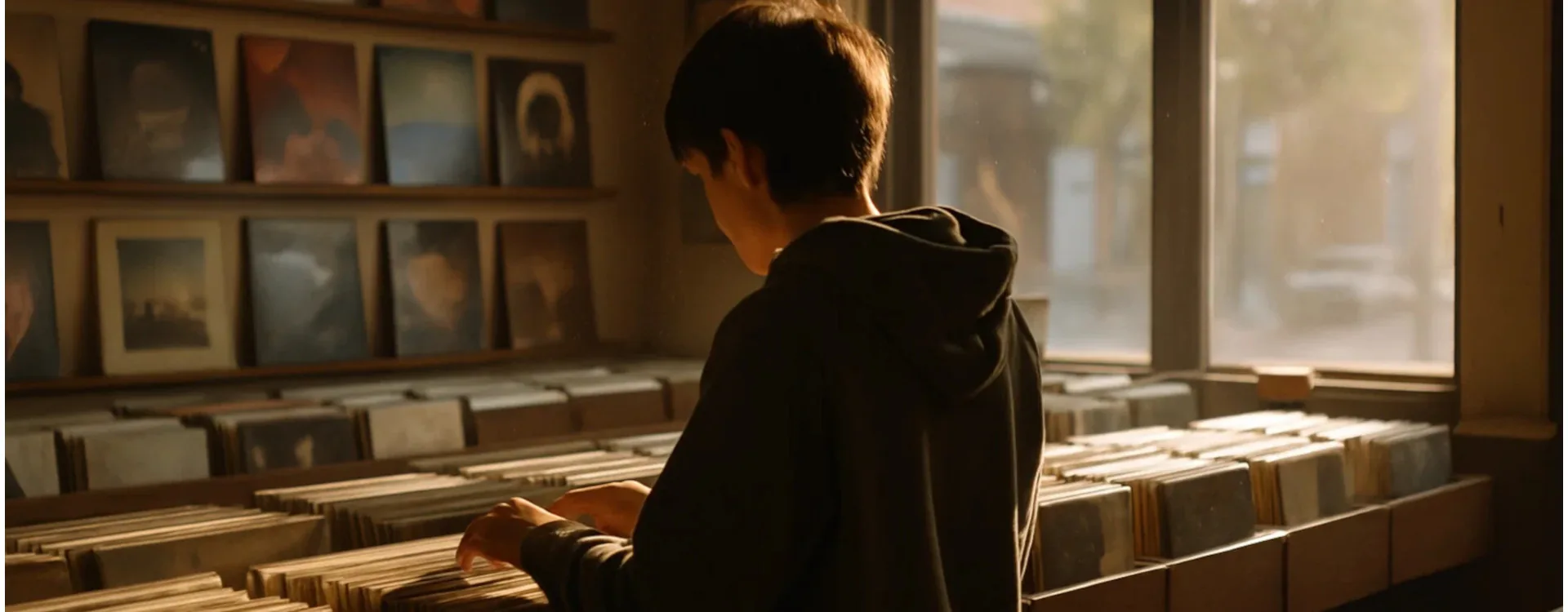
- record stores full of shelves,
- home stereos with a turntable in the living room.
For a teenager in 2025, buying a vinyl record also means connecting to a longer musical story that starts with parents and grandparents and arrives all the way to today.
3. Social reasons: identity, belonging, community
3.1 Vinyl as a marker of identity
When everyone has the same smartphone and listens on the same app, it’s hard to use music to stand out visibly. Vinyl becomes a marker of identity:
- you show your collection in your room,
- you post photos and videos of records on social media,
- you highlight special, colored or limited editions.
It’s not just “listening”, but also self-representation: “these are the artists I care about so much that I gave them money, space and time”.
3.2 Record stores, fairs, listening bars: real places
The vinyl comeback has brought new life to:
- independent record stores,
- record fairs and flea markets,
- bars and listening rooms where the main attraction is the sound system and the records spinning.
In these places:
- you talk with other music lovers,
- you ask the shop owner for recommendations,
- you discover artists while digging through crates.
For a generation that experiences many relationships through a screen, vinyl creates offline social occasions, with people and spaces centered around music.
3.3 Social media and the aesthetics of vinyl
Paradoxically, the digital environment itself gives vinyl an extra push. On social platforms:
- large covers look great in photos,
- colored vinyl and picture discs stand out in videos,
- unboxing limited editions generates comments, shares and curiosity.
Vinyl becomes part of a person’s visual aesthetic and interior design: not only music, but also decoration and style.
4. Anthropological reasons: objects, rituals, cultural “totems”
4.1 The record as a totem object
In anthropology, objects often have a symbolic function: they represent values, stories, belonging. Vinyl records, on a smaller scale, play a similar role:
- they represent an artist or album that has special meaning to you,
- they are a fixed point in space (the record shelf) and time (you come back to them over the years),
- they can be given as gifts, lent, inherited.
Unlike playlists, which change constantly and remain hidden inside an app, vinyl records materialize your bond with music in something you see every day.
4.2 Rites of passage and intergenerational transmission
Vinyl is often at the center of small “rites of passage”:
- the first turntable you receive as a gift,
- the first LP you buy with your own money,
- the family collection passed from one generation to the next.
These moments give music a biographical and family dimension: it’s not just what you listen to, it’s what accompanies you through different stages of life.
4.3 Authenticity and the “human” side of sound
Even though digital can be, technically, more faithful to the studio master, many listeners perceive vinyl as warmer and more “human”. A bit of surface noise, a few clicks, the background hiss:
- remind you that you’re playing something physical,
- make each copy slightly different,
- turn listening into a less “perfect” but more alive experience.
Symbolically, vinyl represents the idea that absolute perfection is not always what moves us the most: a certain degree of imperfection can bring the experience closer to human relationships, which are never flawless.
5. Industry, pop stars and collecting
The vinyl revival is not purely spontaneous: the music industry has understood it and helped fuel it.
- Major pop stars release their albums in multiple variants: colored vinyl, alternate covers, picture discs.
- Limited and numbered runs turn records into true collectible items.
- Events like Record Store Day turn buying a record into a real “treasure hunt”.
For many fans, especially younger ones, vinyl has become a hybrid of:
- music format (you actually play the album on a turntable),
- collectible object (like a rare figure or comic book),
- merchandising (a physical symbol of your fandom).
6. Why it wins over the youngest listeners
Putting all these elements together, we can sum up the reasons for vinyl’s success among the very young:
- it offers physicality in a world of intangible content;
- it proposes a slower pace, the opposite of constant “skipping” through playlists;
- it allows building a visible identity (collections, photos, shelves);
- it creates offline social occasions (stores, fairs, listening bars);
- it fits perfectly with collecting (variants, exclusives, signed copies);
- it connects the present to a longer musical history rooted in the past.
In practice, most young people do not abandon streaming:
- they use it to discover new music,
- while vinyl becomes the way to crystallize the albums that truly matter to them, the ones that “deserve” physical space in their life.
7. What this tells us about our time
The fact that vinyl is still growing in 2025 is not just a market curiosity, but a cultural signal:
- we need physical anchors in a sea of digital content,
- we want to rediscover slow experiences, at least for the things we care about most,
- we look for objects that tell who we are, not only what we happen to be listening to right now.
In this sense, vinyl is not just a way to reproduce music. It is a way to live music: with our hands, with our eyes, with the time we devote to it and with the people we share it with.
8. Glossary of acronyms and terms
8.1 Acronyms
- LP (Long Playing) – Long-playing vinyl format, usually 33⅓ RPM, with a typical album length.
- RSD (Record Store Day) – Annual event dedicated to independent record stores, featuring special vinyl releases.
- Gen Z (Generation Z) – Generation born roughly between the late 1990s and the early 2010s.
8.2 Terms
- Vinyl – Analog music format made of PVC; by extension, the record itself.
- Streaming – Listening to music over the Internet without storing the file locally.
- Crate digging – Searching through boxes and shelves of records in stores and markets, looking for interesting finds.
- Listening bar – Venue where the main focus is high-quality music playback, often from vinyl, on a carefully curated hi-fi system.
- Limited edition – Pressing with a fixed, reduced run, often numbered or with special features (colored vinyl, alternate cover, etc.).
- Collecting – Practice of gathering and preserving objects (in this case records) for emotional, cultural, or economic value.