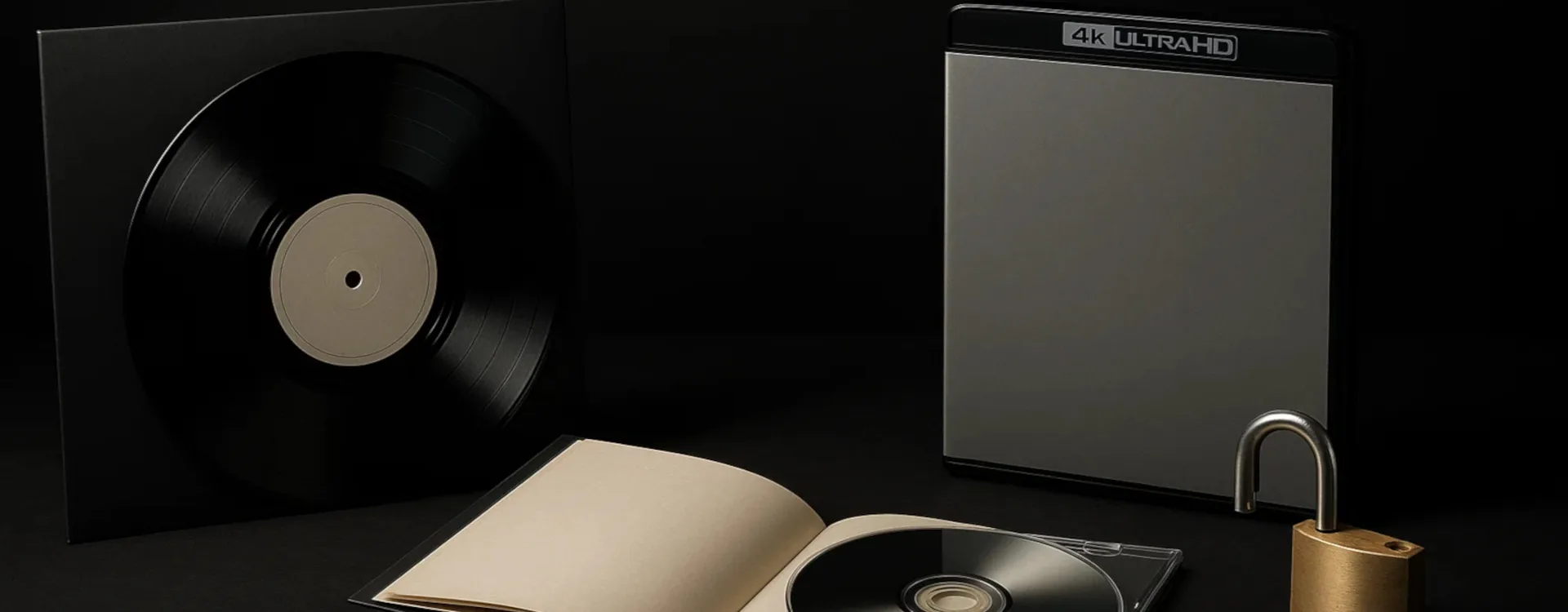
Streaming is convenient, but not always the best choice. For technical fidelity, true ownership, collectible value and real availability, physical formats still win in many real-world cases.
Quick Index
The 2024–2025 snapshot in 5 lines
- Music: vinyl keeps a long positive trend; the slight physical dip is mainly due to CDs.
- US: vinyl accounts for most physical revenues and surpasses CDs in units.
- UK: physical is stable/slightly up; vinyl still rising.
- Home video: overall disc sales decline, yet the 4K niche is lively among collectors.
- Practical read: vinyl = healthy segment; 4K = not mass-market, but high value for quality-seekers and edition lovers.
Quality: when fidelity beats the app
- Well-cut vinyl (known cut/press) delivers dynamics, stage and a full “package” streaming can’t replicate (artwork, inserts, booklets).
- 4K UHD: with a true 4K DI, higher bitrates and HDR (HDR10/Dolby Vision), plus lossless/immersive audio, the disc is the reliable route.
- Boutique labels curate restorations, authoring and premium packaging that hold value over time.
Ownership & availability: actually having what you love
- The disc is yours: no license shifts or catalog removals; you can resell, gift, collect.
- “Complete” versions: bonuses, booklets, full artwork, special mixes (Atmos on BD-Audio, director’s cuts on 4K).
- Stability: no surprise quality downgrades or temporary takedowns by platforms.
Longevity & long-term value
- Vinyl: steady demand; first presses, “signature” cuts and numbered runs retain value.
- 4K: smaller runs, bespoke artwork, slips/steelbooks; lower volume, higher perceived rarity for collectors.
When physical beats streaming (quick checklist)
- You want the best version available (true 4K, well-authored HDR, reference mastering).
- You need stability: no removals/licensing issues; freedom of use over time.
- You collect artwork, inserts, limited variants and premium packaging.
- You support artists/labels with higher-value purchases (especially for indie projects).
How to choose well (in 5 steps)
- Identify the exact edition (EAN, country, year): avoid mix-ups with reissues.
- Read the technical details: deadwax/pressing (vinyl), DI/HDR/codec (4K).
- Check run size and extras (OBI, booklet, slip, poster).
- Pick your goal: listening, collecting or long-term hold.
- Move early on small runs: OOS often equals price hikes later.
Featured for You
Take a look at our New Releases and curated High-Quality selection: premium editions, reference masterings, true 4K discs.
New Releases
Fresh vinyl, CDs and 4K—limited variants and small runs included.
High-Quality
AAA cuts, half-speed masterings, premium pressings and true-4K HDR authoring.
Quick FAQ
Does 180g always sound better?
No: mastering, cut and pressing plant matter more. Weight alone doesn’t guarantee sound quality.
Is 4K streaming the same as the disc?
It depends. Discs usually offer higher, more stable bitrates, more consistent HDR metadata and lossless/immersive audio.
Is it worth buying now?
Yes: vinyl trends positive and many 4K/steelbook editions are short-run—top titles sell out and climb in price later.
Technical Glossary (tap to open/close)
- Deadwax / Runout
- Shiny area between last groove and label on vinyl. Holds mastering initials, studio stamps and pressing codes.
- Matrix (vinyl/CD)
- Code etched (vinyl) or in the inner hub (CD/BD) identifying edition/lot. Useful to distinguish different pressings.
- Mastering
- Final stage optimizing sound and levels for the medium. On vinyl it ties directly to the lacquer cut.
- Lacquer cut / Cut by
- The cutting of the lacquer that creates the stamper. Often credited by initials in the deadwax (e.g., RL, BG, KG, CB).
- Pressing plant
- Factory that presses discs (e.g., Optimal, Pallas, MPO, GZ). Quality/consistency vary by plant and period.
- Recut
- A new cut of the lacquer (e.g., A2/B2 after A1/B1). It can change the sound versus the first cut.
- First press / Reissue
- Initial run vs later reprint. First presses are often more collectible; reissues can sound better if sourced/handled well.
- OBI
- Japanese paper strip with info in Japanese. Part of the edition; increases value if original and intact.
- Hype sticker
- Informative sticker on the sleeve (run size, color, remaster, bonuses). Keep it for completeness.
- Anti-static inner sleeve
- Reduces static and micro-scratches; recommended to preserve vinyl.
- Ringwear
- Circular rub mark on a sleeve from the disc inside; reduces grading.
- Seam split
- Split along sleeve edges or inner sleeves, often from transit; affects value.
- Picture disc
- Vinyl with printed artwork. Eye-catching, sometimes noisier than standard vinyl.
- 180g
- Heavier vinyl for stability/flatness; weight alone doesn’t ensure better sound.
- Gatefold
- Folding “book-style” sleeve; often includes booklets, photos and lyrics.
- True 4K (4K DI)
- 4K disc mastered from a native 4K Digital Intermediate—usually sharper than a 2K upscaled source.
- HDR10 / Dolby Vision
- High Dynamic Range formats for 4K UHD. DV uses dynamic metadata for scene-by-scene tone mapping.
- Dolby Atmos / DTS-HD MA
- Disc audio formats: Atmos (object-based immersive), DTS-HD Master Audio (lossless multichannel).
- Bitrate (video/audio)
- Data per second. Discs typically run higher, steadier bitrates than streaming, improving picture and sound.
- Region code (BD/4K)
- Geographic playback restriction (Blu-ray; most 4K discs are region-free). Always check before buying.
- Slipcase / Slipcover
- Cardboard outer cover (often limited/numbered) that adds protection and perceived value.
- Steelbook / Amaray
- Metal artwork case (steelbook) versus standard plastic case (amaray). Steelbooks tend to be shorter-run and highly collectible.
- Boutique label
- Small labels focused on curated editions (restorations, rich booklets, limited runs) for collectors.
- IFPI SID codes (CD/BD)
- Inner hub codes identifying mastering plant (Lxxx) and mould plant (xxxx). Useful for authenticating an edition.
- BD-66 / BD-100
- 4K UHD disc capacities (66GB/100GB). BD-100 allows higher video bitrates.
- AAA / Half-speed mastering
- AAA: fully analog chain (record/mix/master). Half-speed: cut at half speed for more precise certain-frequency handling.