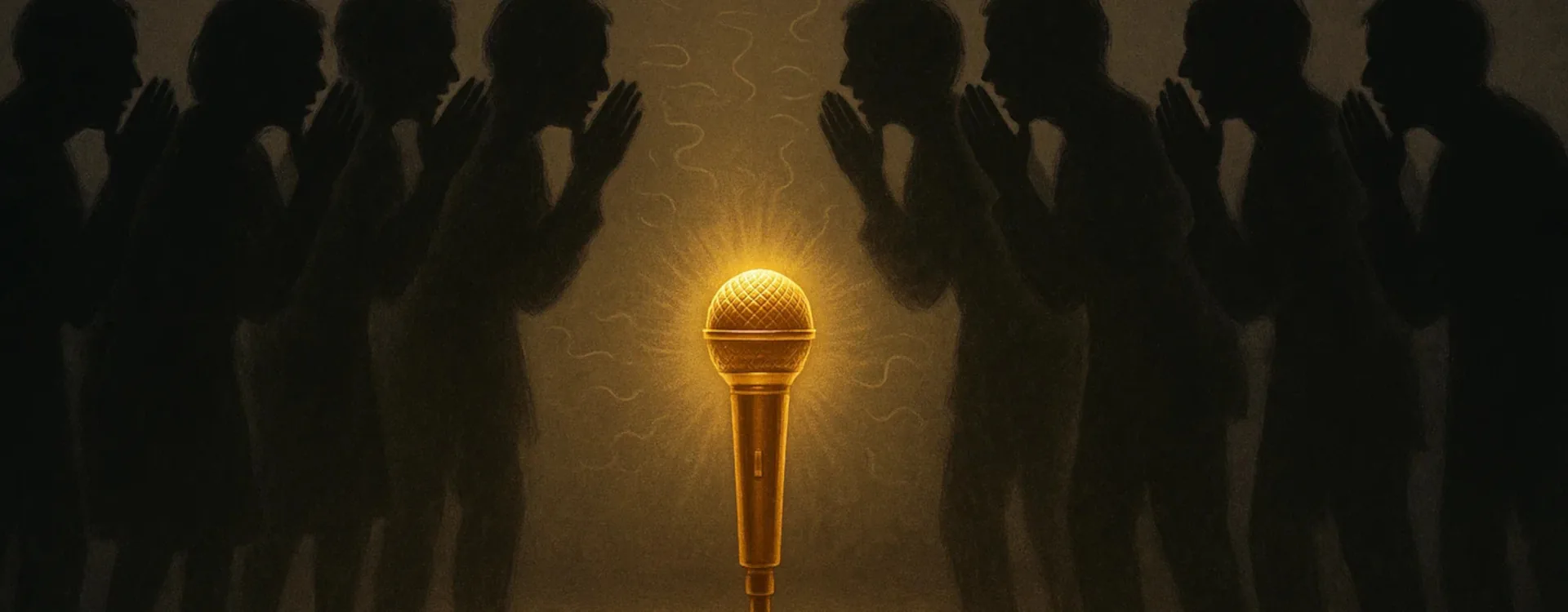
Endless credits have become the norm: eight, ten, even twelve names for a single track. Yet no one would accept a poem written by a committee. Songs, like poetry, live through a voice and a recognizable feeling. That’s why I state it clearly: an important song cannot be written by ten hands. Everything else is, more realistically, industrial production.
The Thesis (Without Evasion)
- The song is closer to poetry than to cinema: it requires an “I,” not a committee.
- Authorship = music and/or lyrics: arrangement, sound design, mix, and performance may be excellent, but they do not replace the artistic authorship of words and melody.
- Beyond 3–4 pens on the song’s core (lyrics/melody), industrialization almost always prevails: the emotional center is diluted in compromises.
- A lasting song has a single emotional voice: everything else is packaging, no matter how perfect.
The Foundation: Emotion Before Aesthetics
A song is not art because it “sounds good”: it is art if it conveys a recognizable emotion. Aesthetic refinement can amplify it, but never replace it. The metaphor is simple: could we imagine a sonnet written by multiple hands and still preserving urgency and unity of voice? No. The same logic applies to songwriting.
Anatomy of Emotional Transmission
Emotion emerges when every level serves the same intention:
- Lyrics: imagery, vocabulary, point of view. Credibility comes from a clear narrator.
- Melody: the grammar of feeling (leaps, tensions, resolutions).
- Harmony: the affective color interpreting the lyrics.
- Rhythm: the emotional breath, not just a trend.
- Timbre/Production: a sonic direction that interprets, not standardizes.
- Prosody: when lyrical stress and musical stress overlap, truth arises.
If these layers result from serial compromise, emotion fades: what remains is the sound of the moment, not a true voice.
Why “Ten Authors” Almost Never Work
- Dilution of subject: more pens, less center. The question “who is speaking?” gets lost.
- Permanent compromise: what survives is what pleases everyone—the emotion becomes neutral.
- Algorithmic optimization: songs are written for metrics (skip rate, 15-second hooks) rather than expression. They work, but they don’t move us.
- Defensive credits: micro-contributions and interpolations inflate names, not emotional truth.
Collaboration is not the problem: the problem begins when it replaces emotional direction with an assembly line.
When Collaboration Ignites Emotion (Rather Than Weakens It)
- Authoritative duo (music + lyrics): two voices, one vision.
- Trio with producer-author: the producer interprets dramaturgically, not flattens.
- Small stable lab (2–4 people): shared identity, common language.
- Writing camp with a single direction: many inputs, but one pen rewrites and signs the heart of the song.
In all cases, lyrics and melody must have a clear responsible core. The rest serves the work.
Poetry in Music: The Voice Test
- Who speaks? Is the “I” identifiable, or is it a blurry “we”?
- Prosody: do key words fall where the music highlights them?
- Vulnerability: is there personal risk, or just perfect slogans?
- Memory: after 24 hours, do we remember an image or just the sound?
If these tests fail, it is not art: it is packaging.
Art vs Product: The Updated Grid
- Authorial voice beyond the trend.
- Internal coherence across lyrics, melody, harmony, production.
- Aesthetic risk preferred over compromise.
- Expressive necessity: would the song hold up without the “sound of the moment”?
- Emotion that is clear and personal at both first and repeated listens.
- Non-replicability: without that author, it would not sound the same.
- Author threshold: beyond 3–4 on the song’s core, the signal is industrial, not artistic.
Objections (and Straight Answers)
“But art has always been collaborative!”
Cinema, yes. A song is a sung monologue. Collaboration can amplify, but it cannot replace the voice.
“Painters had workshops too”
The master’s signature remained: direction was his. Same in songs: many hands are fine, but one guides the core (lyrics/melody).
“Many credits because production is writing”
True when it interprets. Not when it standardizes into formats.
“If it sells, it moves people”
Sales measure exposure, not depth. Emotion is measured over time.
Concrete Steps to Put Emotion Back at the Center
- Transparent credits: who wrote lyrics and melody (names, not an indistinct list).
- Visible splits (even in ranges) to show the creative core.
- Author’s notes: five lines on the intended emotion and choices made to protect it.
- Raw version: release a voice+piano or voice+guitar take: if it works, it’s a song; if not, it’s just sound.
- Ethical editing: cut what “works” but betrays the voice.
Conclusion: A Voice That Moves, Not a Committee That Convinces
I welcome every technical and performative role; I celebrate them when they serve the song. But artistic authorship remains a narrow responsibility: one, at most a few. Art is not the sum of well-made parts: it is a voice that reaches us whole.
That is why I state it bluntly: an important song cannot be written by ten hands. If it ever happens, it is a rare exception. In almost all cases, beyond that threshold we are no longer speaking of art, but of music industry products.