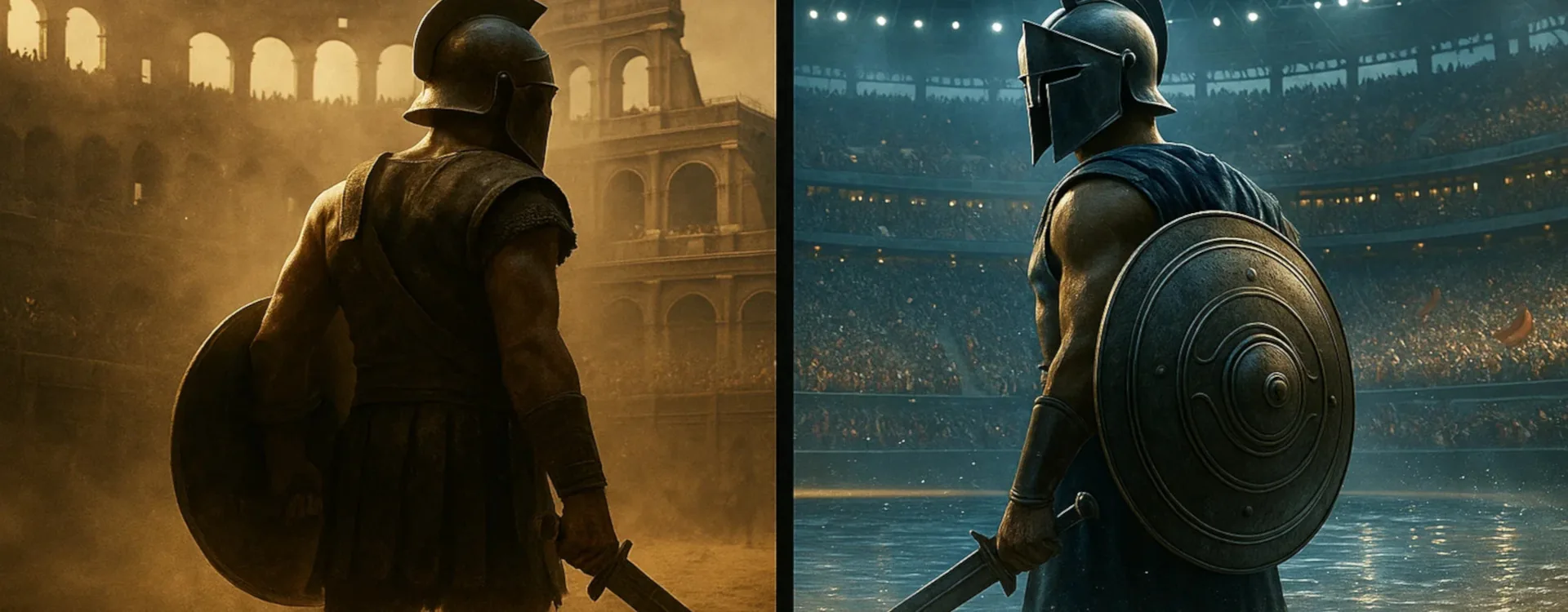
Ridley Scott returns to the arena with Gladiator II: star power, oversized sets, water and blood everywhere. But does the bigger scale bring bigger meaning? Here’s a sharp review with a clear-eyed look at the acting and a frank comparison to the 2000 landmark Gladiator.
Context in 8 lines
- Release window: late 2024; runtime roughly two and a half hours.
- Main cast: Paul Mescal (Lucius), Denzel Washington (Macrinus), Pedro Pascal (Acacius), Connie Nielsen (Lucilla), Joseph Quinn (Geta), Fred Hechinger (Caracalla).
- Director: Ridley Scott. Spectacle-first staging with “arena showpieces.”
- Score: Harry Gregson-Williams, with thematic nods to the sonic world of the first film.
Thesis (no frills)
Gladiator II is bigger than the first, not greater. Scott leans on eye-candy—flooded arenas, menagerie-like “boss fights,” hypertrophic set pieces—and often finds energy but not always necessity. The epic look is here; the epic ache is diluted by tonal whiplash and the urge to out-muscle the original.
The script braids revenge, power games, and imperial satire; compared to Maximus’s clean-through line, the sequel feels more disjointed and bombastic. It entertains; it rarely wounds.
Acting: who actually wins the arena
Paul Mescal (Lucius) vs Russell Crowe (Maximus)
Mescal brings physical intensity and a credible haunted stare: you feel the fighter’s discipline and the character’s hurt. What’s missing is Crowe’s gravitas—that muscular stillness that held the frame even in silence. Crowe won with what he didn’t say; Mescal dominates in close combat, less so in mythmaking.
Denzel Washington (Macrinus)
The film’s true scene-stealer. Velvet charisma, threat without shouting, the dry wit of an ancient kingmaker. Every entrance raises the dramatic stakes and the moral temperature. When he side-eyes a foe, the movie sharpens.
Pedro Pascal (Acacius)
Pascal humanises the general: superb soldier, tired man. It’s the most modern performance here—less monolithic, more cracked. He deserved a tighter third-act arc.
Connie Nielsen (Lucilla)
Nielsen brings tragic dignity and continuity with the original: the way she reads Rome is worth more than a page of exposition. The script, however, uses her too often as a narrative bridge rather than an engine.
Joseph Quinn & Fred Hechinger (Geta and Caracalla)
Deliberately grotesque duo: they work as a cartoon of power but tilt the tone toward dark farce, draining oxygen from tragedy. A conscious choice that will please satire fans and frustrate epic purists.
Direction & staging: power, with finesse on alternating days
Scott is still a master of choreographed spectacle: readable battles, clear geography, colossal builds. Yet the sequel embraces a scale that slides into “festival of excess” (rhinos, tanks, aquariums) and an impatient edit. The camera runs faster than the story; impact lands, emotional echo doesn’t always follow.
Music: the ghost of Zimmer and Gregson-Williams’ path
Harry Gregson-Williams doesn’t try to clone Zimmer: he updates the palette with chorus and ancient timbres, quotes where needed, and looks for his own identity. Solid work—less iconic, more ensemble-minded—which fits a film that’s broader and less singular than the original.
Head-to-head with Gladiator (2000): why the first holds better
- Emotional arc: the 2000 film was a spear—honour → fall → rise → catharsis. Here Lucius swings between revenge and intrigue, and the perspective isn’t always locked.
- Antagonist: Commodus was a classic, memorable villain; the Geta/Caracalla duo is fun as satire, not as tragic counterweight.
- Coherence: the first balanced pathos and spectacle; the second privileges scale over breath. You’re impressed, not always involved.
What works (and what doesn’t)
- Works: Washington’s magnetism; some of the beefiest arena sequences in years; smart use of space; photography that loves skin and metal; sturdy score.
- Works less: lurching tone (tragedy ↔ satire), a hurried third act, caricatured antagonists, “wow” set pieces that eat the pathos.
Verdict
Score: 3.5 / 5. Gladiator II is hefty entertainment with flashes of real cinema, yet it stands in the long shadow of a classic. Mescal convinces in sweat, less in legend; Washington dominates; Pascal is the weary heart we wanted more of. If you seek visual wonder, you’ll be fed; if you crave the emotional wound that left you upright during the 2000 end credits, you’ll feel it less here.
Is it worth owning at home? Formats compared (DVD, Blu-ray, 4K UHD, streaming)
Theatrical run’s over, but there are good reasons to revisit—or collect—Gladiator II at home. Here’s when each format makes sense and why.
DVD (Standard Definition)
- Why yes: cheapest and universally compatible; often includes Italian language/subs; fine if you just want it on the shelf and don’t care about HD.
- Why not: limited picture (no HD/HDR), typically lossy audio; artefacts and softness show on medium/large TVs.
- Best for: bargain buyers, small secondary TVs (kitchen/bedroom), completists on a budget.
Blu-ray 1080p (Full HD)
- Why yes: big jump over DVD: cleaner image, far more detail; often lossless audio (Dolby TrueHD or DTS-HD MA); great value.
- Why not: no HDR or wide colour; on a good 4K HDR display, some impact is left on the table.
- Best for: TVs up to ~55" or longer viewing distances; collectors who want quality without going all-in on 4K.
Blu-ray 4K UHD (2160p with HDR)
- Why yes: the definitive home version: finer detail, HDR for richer highlights/shadows and colour (10-bit, wider gamut); premium audio (Atmos/DTS:X depending on the edition). Arena scale, water, fire, skin and metal really sing.
- Why not: pricier and needs proper hardware (HDR TV/projector + UHD player); with a basic setup the advantage shrinks.
- Best for: anyone chasing reference quality, screens 55"+ or projection, dedicated audio setups, curated collections.
Streaming (4K/HD digital)
- Why yes: instant and convenient; often offers 4K with HDR and Atmos (service-dependent); perfect to rewatch once or “trial” before buying a disc.
- Why not: lower bitrate than discs: less fine detail, more compression in smoky, dark, or water-heavy scenes; quality varies with bandwidth.
- Best for: viewers who prioritise convenience and price, or don’t care about physical media.
My home-video verdict for “Gladiator II”
- Chasing arena/WOW factor? 4K UHD is the pick: HDR elevates water, fire, skin and armour; 3D audio sells the crowd and clashes.
- Best value? Blu-ray 1080p is excellent—especially on non-giant TVs.
- Just want to own it cheaply? DVD does the job for secondary sets.
- Want it now with zero friction? Streaming is great, knowing discs still win on sheer fidelity.
Tip: always check edition details (HDR10/Dolby Vision, Atmos/DTS:X, ITA subs, region code) and whether worthwhile extras are included (making-of, commentaries). On a set-piece-driven title, those can be half the fun.
Quick guide (for the undecided)
- See it in theatres? It’s no longer playing—home formats above are your options.
- Love the original? Go in knowing the feeling isn’t the same; enjoy the craft, temper the myth.
- Chasing adrenaline only? Approved.
- Chasing “classical” tragedy? Half-satisfied.