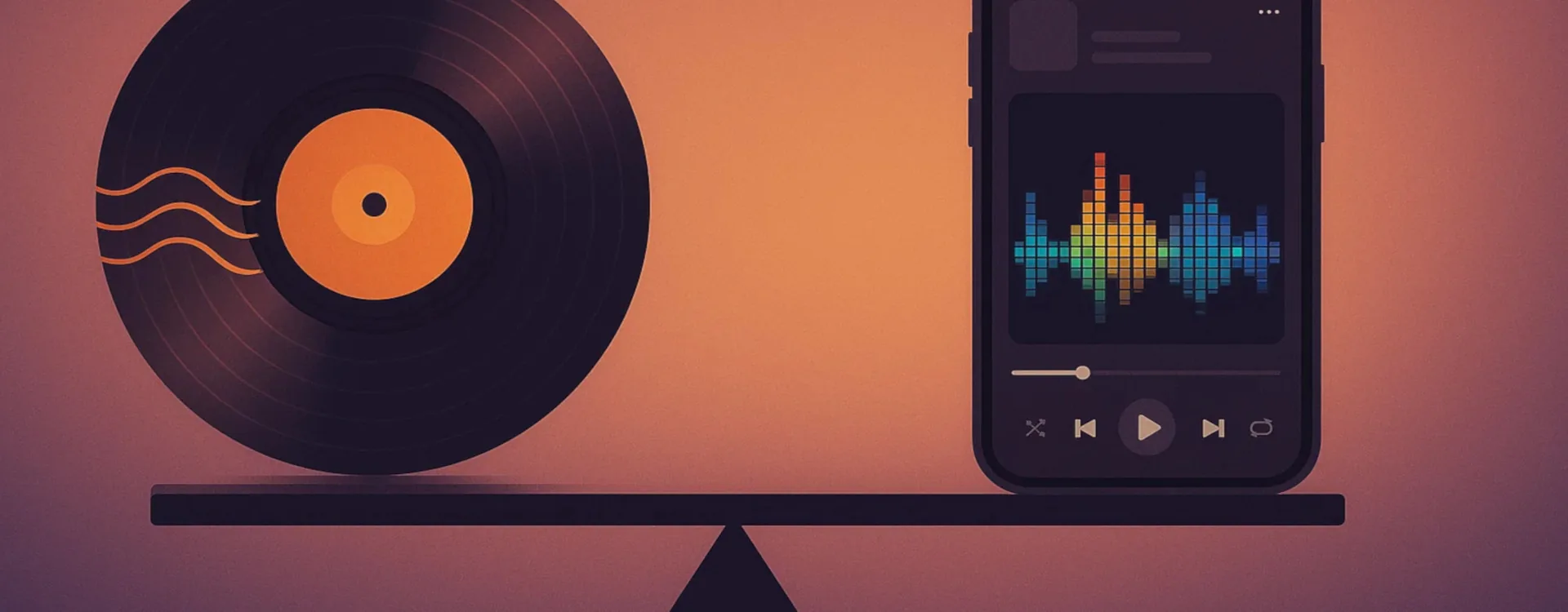
Streaming has conquered convenience and discovery, but physical formats remain irreplaceable for those who seek control, collecting and — often — a different sound. Here’s an in-depth comparison between Spotify and physical media (vinyl, CD, SACD), from technical details to real listening.
1) What do we really mean by “audio quality”?
Talking about quality requires distinguishing between codec/format (how music is encoded), mastering (how it was produced), and playback (gear and room). If one of these legs is weak, the whole experience collapses.
CD: 16 bit / 44.1 kHz PCM (“Red Book” standard). The historical reference for optical digital audio.
SACD: DSD layer at 2.8224 MHz (1-bit), with potential for discrete multichannel; often hybrid discs also readable as standard CDs.
Vinyl: an analog medium with wide variability between editions; performance depends heavily on mastering, pressing and playback setup.
Spotify: subscription streaming; now with lossless available in selected markets, while on mobile and Bluetooth true bit-perfect output depends on codecs and playback chain.
2) Mastering: the factor you actually hear
Two editions of the same album can sound radically different because of mastering. Vinyl almost always requires a dedicated master (bass handling, sibilants, levels, stereo image) to respect the physical groove limits. Digital masters can also vary a lot, from heavily compressed to wide dynamics.
Bottom line: what you hear is the mastering, not just the container. A well-mastered LP can sound more engaging than a poor digital release — and vice versa.
3) Dynamics and resolution: numbers that matter (but aren’t everything)
In theory, CD (16 bit) offers ~96 dB of dynamic range; 24-bit masters go well beyond; SACD/DSD extends bandwidth and often includes multichannel. Vinyl typically achieves lower dynamic values in practice, but can deliver a “texture” that many listeners appreciate. Still, if the master is squashed, no format will save it.
4) Catalogue and availability: everything now vs forever
Streaming gives instant access to an immense catalogue, but you own nothing: albums can appear and disappear. With discs, you own the work: you can keep it, resell it, lend it. It’s the difference between a service and a good.
5) Ownership, object, cultural value
A vinyl or SACD isn’t just a playback medium: it’s a cultural artifact. Artwork, booklets, credits, dedicated mastering; a tactile and visual relationship that streaming cannot replicate. On the other hand, streaming excels in discovery and sharing: playlists, links, recommendations, instant listening anywhere.
6) Costs: subscription vs collection
Streaming costs a monthly subscription and gives access to millions of tracks. Physical collecting is more expensive per title but creates patrimonial and emotional value. With the same yearly budget you can choose “tons of liquid music” or “fewer titles but yours forever”. There is no universal answer: it depends on how much you collect and how you listen.
7) Gear and real performance: where differences show
The jump from lossy to lossless (also in streaming) is noticeable mostly on wired chains and quality DACs. Over Bluetooth, performance depends on available codecs: in many scenarios the difference is smaller. Vinyl, on a well-calibrated setup (cartridge, tracking force, alignment), can deliver that grain and tridimensionality many crave. CD and SACD offer convenience, no wear, and in SACD’s case, discrete multichannel on compatible titles.
8) When to choose which format
Choose Spotify
If you want constant discovery, playlists, sharing, on-the-go listening and decent quality without handling files or backups.
Choose CD
If you need plug-and-play convenience, reliable 16/44.1 quality and durable copies at reasonable prices.
Choose SACD
If you’re looking for audiophile editions, DSD and multichannel where available. Requires dedicated player and selective catalogue.
Choose Vinyl
If you love the object, the ritual, and — with a good master — a different and rewarding listening experience. Requires care and maintenance.
9) Pros and cons in brief
Spotify
- Pros: huge catalogue, discovery, sharing, improving quality.
- Cons: you own nothing; albums disappear; variable performance over Bluetooth.
CD
- Pros: stable quality, no wear, practical.
- Cons: less “romantic” than vinyl; no multichannel unless another format.
SACD
- Pros: DSD, often 5.1, generous headroom.
- Cons: limited catalogue; dedicated hardware needed.
Vinyl
- Pros: dedicated mastering, tactile experience, collectability.
- Cons: maintenance, wear and surface noise; lower effective dynamics.
10) Three realistic use cases
Smart home & mobility
Network streamer + app + wireless headphones: streaming is unbeatable for convenience. Use wired connections in your main listening room.
Collector & hi-fi rig
CD/SACD for quality and reliability, vinyl for special editions. Room treatment matters more than specs on paper.
Hybrid listener
Discover on Spotify, buy on disc what you want to own forever or in the best editions. Mixing both is the smartest solution.
11) Frequently asked questions (FAQ)
- Does lossless streaming “match” a CD?
- As a container, yes, on proper playback chains. Final quality still depends on mastering, DAC and playback path.
- Why do some LPs sound “better” than the streaming version?
- Often because they use different masters: vinyl may have dedicated EQ and dynamic choices.
- Does SACD always sound better than CD?
- It depends on edition and playback chain. Its true advantage lies in multichannel and carefully curated masters.
- Should I switch entirely to vinyl?
- No if you’re only looking for “better quality”: vinyl is a different experience, requiring maintenance and space. It’s about pleasure, not dogma.
Conclusion: not “better or worse”, but “how and why you listen”
Spotify is perfect for discovering, sharing and listening everywhere; physical formats are for what you truly want to own, preserve and — sometimes — enjoy with dedicated mastering. The format matters, but mastering played on the right chain is what wins. Hi-Fi is not a race of numbers: it’s a relationship between music, people and real contexts.
Beyond all this, along with practical considerations of convenience and technical sound quality, comes the truth that few admit: streaming has changed the rules, but it will never fully replace the cultural and sensorial value of the record. Spotify has made music convenient, but it has stripped the ownership and ritual of the physical medium of its centrality: this is the wound that many refuse to acknowledge.