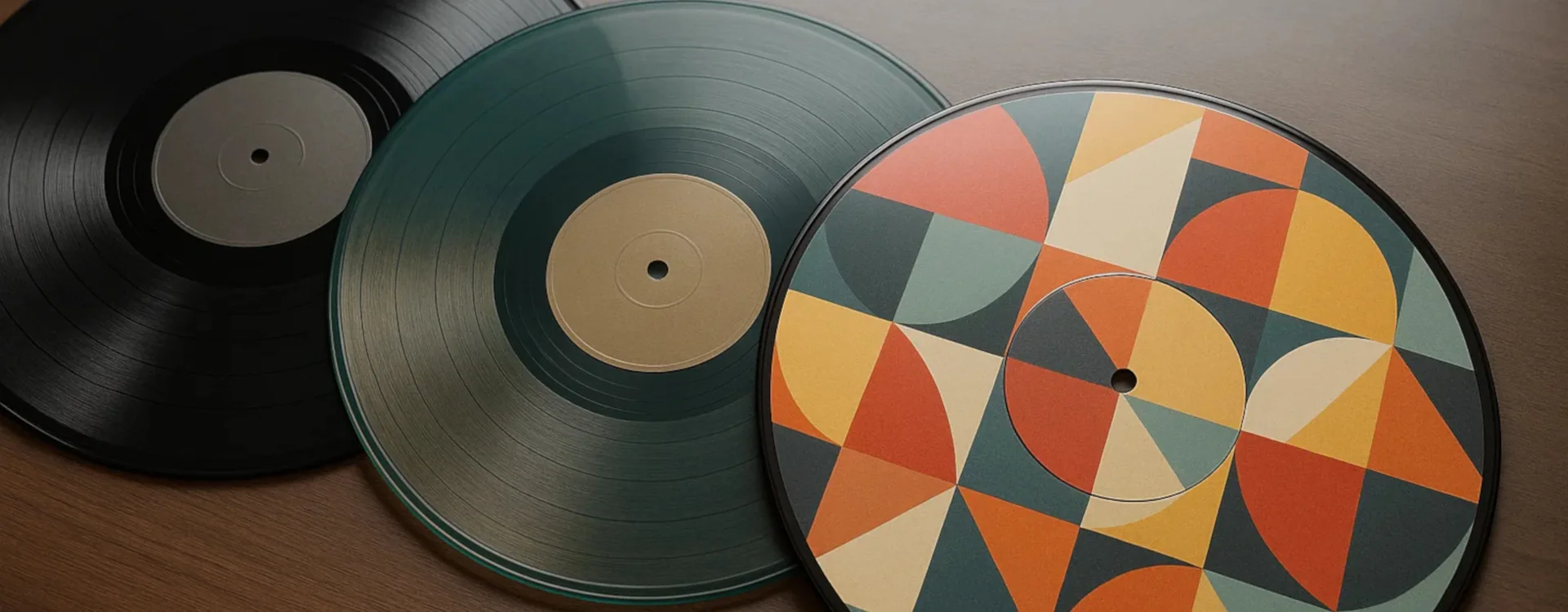
Why color can (slightly) affect sound
A record is PVC plus additives. Color isn’t just aesthetics: it changes thermal conductivity, surface hardness, and lubrication during pressing. These influence surface noise, groove definition, and the risk of non-fill (PVC not fully flowing into the stamper).
Black vinyl: why it remains the standard
Black compound contains carbon black, which increases mechanical strength, improves heat transfer in the mould, and shields against UV.
- Pros: on average lower noise floor and better copy-to-copy consistency.
- Cons: none intrinsic to audio; quality still depends on process.
Colored vinyl: transparent vs. opaque
Transparent (no opacifiers)
- Uses dyes that don’t load the PVC with bulky fillers.
- With an optimized press cycle can be nearly as quiet as black.
- Great when you want aesthetics without sacrificing much performance.
Opaque / Pastel (with opacifiers, e.g., whites)
- May include opacifiers (e.g., TiO2) that increase friction and complicate PVC flow in the stamper.
- Slightly higher risk of non-fill and whoosh unless temperature/pressure/dwell are adapted.
- Can sound great, but needs a tighter process and stricter QC.
Special effects: marble, splatter, half-and-half, glitter, glow
- Marble / Splatter: blends of compounds with different viscosity; can sound good, but copy variability increases.
- Half-and-half / tri-color: internal seams in the “puck”; potential micro-inhomogeneity in groove walls.
- Glitter / metal flakes: hard particles in the groove ⇒ higher noise and potential stylus wear.
- Glow in the dark (phosphorescent): aggressive pigments; almost always noisier.
Picture discs: allure and limits
They’re a sandwich: printed image in the middle with two thin clear PVC layers outside, where the groove is pressed. That layer is thinner and less damped than a solid record.
- Pros: visual impact, collectible object.
- Cons: higher surface noise, more sensitive to setup, lower micro-detail.
Beyond color: the factors that really matter
- Mastering & cut: appropriate levels, inner-groove care, the cutting engineer’s touch.
- Plating (mothers/fathers/stampers): uniformity, nickel deposition, stamper life (less wear = better copies).
- Press & recipe: temperature, pressure, dwell, cooling, compound.
- Quality control: clean stampers, trim removal, batch testing across multiple copies.
- Sleeving & logistics: anti-static inners vs. dusty paper; no “free in jacket”; avoid heat/solar storage.
Myths to bust
“180 grams = better sound”
Weight helps flatness and inertia, but doesn’t guarantee better-formed grooves.
“Colored always sounds worse”
Flatly false: many transparent pressings sound excellent. Problems arise with opacifiers/over-the-top effects and non-optimized cycles.
“Modern picture discs sound like black”
Improved, yes; parity only in rare cases. The construction is inherently noisier.
Buying checklist (practical)
- Source & cut: ask about the master (AAA? hi-res?), who cut it (initials in the deadwax), and the pressing plant.
- Vinyl type: for quality, choose black or simple transparent; avoid glitter/glow if you want very quiet backgrounds.
- Format: 12″ at 45 rpm often yields better dynamics and tracking (more space = less groove compression).
- Inner sleeve: switch to quality anti-static inners immediately.
- Cleaning: RCM or proper solution before the first play (remove mold release agents).
- Turntable setup: correct VTF, anti-skate, alignment, clean mat. A MicroLine/Shibata stylus reveals fewer ticks than a conical.
Quick comparison (audio before looks)
Black (with carbon black)
- Quiet surfaces: ⭐⭐⭐⭐☆
- Copy consistency: ⭐⭐⭐⭐⭐
- Audio recommended: yes (default)
Transparent colored
- Quiet surfaces: ⭐⭐⭐⭐☆ (when well-pressed)
- Variability: ⭐⭐⭐☆☆
- Audio recommended: yes (often indistinguishable from black)
Opaque/pastel colored
- Quiet surfaces: ⭐⭐⭐☆☆
- Non-fill risk: ⭐⭐☆☆☆ (if cycle not optimized)
- Audio recommended: only very carefully made editions
Picture disc
- Quiet surfaces: ⭐⭐☆☆☆
- Aesthetic value: ⭐⭐⭐⭐⭐
- Audio recommended: for collection, not analysis
FAQ
Are white pressings noisier?
Often yes, due to opacifiers. But an attentive plant can achieve excellent results.
Better black or colored for audiophile use?
On average black, but a well-pressed transparent is often indistinguishable.
Do picture discs damage the stylus?
No—if in good condition and with correct VTF. They are, however, noisier, so keep cleaning and setup on point.
Do “marble” and “splatter” editions sound worse?
It depends on process. Copy-to-copy variability is higher: research the specific pressing.
Glossary
- Carbon black
- Additive in black vinyl: improves strength, heat conduction, and UV shielding.
- Non-fill
- Pressing defect: PVC fails to fill the stamper, producing hiss/scratchy metallic noises.
- Mold release
- Residual release agent from pressing; should be removed with an initial clean.
- Deadwax
- Runout area near the label, often bearing the cutting engineer’s initials.
- Inner grooves
- Final tracks toward the center: more critical for distortion and tracking.